Architecture overview
Anton has a brain-inspired architecture. The user docs deliberately use plain names (memory, lessons, skills); in the contributor docs we use the real module names — hippocampus, cortex, cerebellum, ACC, striatum — because the code does. If you want the full rosetta stone, start with Brain mapping.
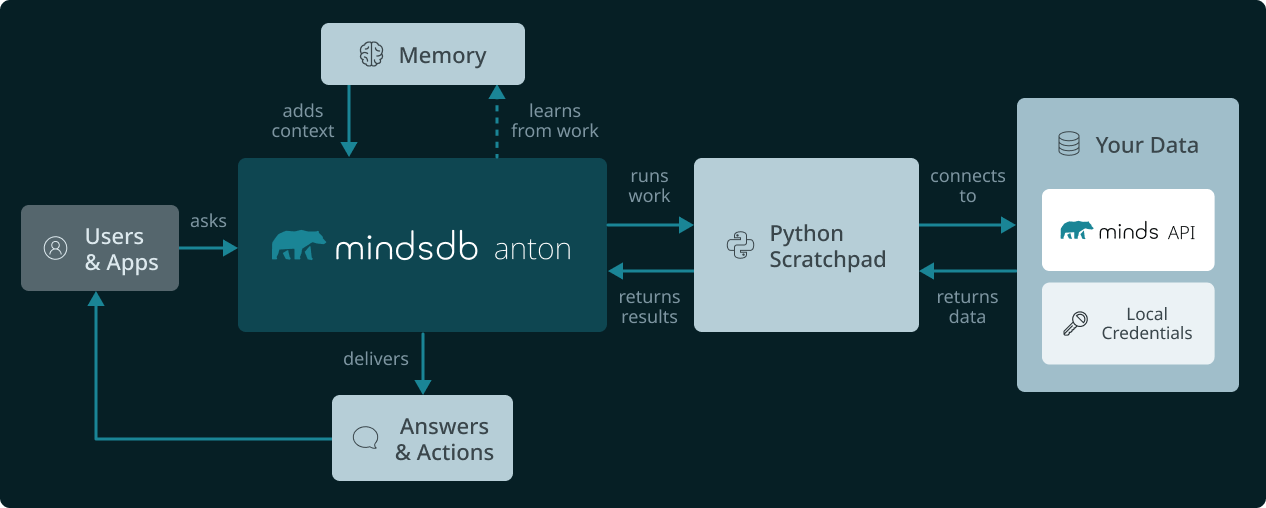
At the highest level there are three layers:
- The executive (orchestrator) — the chat loop plus
ChatSession. It plans, picks tools, monitors progress, and decides when to stop. - Scratchpads (working memory) — isolated Python reasoning environments where most actual work happens. See Scratchpad runtime.
- Long-term stores — the experience store (episodic memory), the declarative memory files (engrams), the cerebellum/ACC error-learning loop, and the skill library (procedural memory).
  ┌────────────────────────────────────────────────────┐
  │              EXECUTIVE (the orchestrator)          │
  │                                                    │
  │  On new problem:                                   │
  │    1. Check SKILL LIBRARY → match?                 │
  │       YES → recall_skill(label) → load procedure   │
  │       NO  → open fresh scratchpad                  │
  │    2. Monitor scratchpad progress                  │
  │    3. Detect stuck/failure → pivot strategy        │
  │    4. On success → record to experience store      │
  └────────────┬────────────────────↑──────────────────┘
               │ spawns & monitors  │
               ▼                    │
  ┌──────────────────────────────────────────────────────┐
  │              SCRATCHPADS (working memory)            │
  │                                                      │
  │  Each scratchpad is:                                 │
  │  - An isolated reasoning environment (its own venv)  │
  │  - A chain-of-thought trace (code + observations)    │
  │  - Has a goal, constraints, and a budget             │
  │  - Can request sub-scratchpads (decomposition)       │
  │                                                      │
  │  Every cell execution fires pre/post hooks observed  │
  │  by the CEREBELLUM (post-mortem error learning).     │
  └──────┬──────────────┬───────────────────┬────────────┘
         │              │                   │
         │ on success   │ on cell errors    │ on success
         ▼              ▼                   ▼
  ┌────────────┐  ┌──────────────┐  ┌─────────────────────┐
  │ EXPERIENCE │  │  CEREBELLUM  │  │   SKILL LIBRARY     │
  │   STORE    │  │              │  │                     │
  │ (hipp.)    │  │ Buffers bad  │  │ /skill save → LLM   │
  │            │  │ cells, runs  │  │ drafts a procedure  │
  │ Episodes — │  │ post-mortem  │  │ with label + name + │
  │ JSONL log  │  │ via LLM,     │  │ description +       │
  │ of every   │  │ encodes new  │  │ declarative_md.     │
  │ turn.      │  │ lessons via  │  │                     │
  │            │  │ Cortex.      │  │ Future turns recall │
  │ Recall via │  │              │  │ the procedure via   │
  │ `recall`   │  │ Lessons feed │  │ recall_skill tool.  │
  │ tool.      │  │ next code    │  │                     │
  │            │  │ generation   │  │ Stored at           │
  │            │  │ (procedural  │  │ ~/.anton/skills/    │
  │            │  │ priming).    │  │   <label>/          │
  └────────────┘  └──────────────┘  └─────────────────────┘
The brain analog: the executive (PFC) plans and delegates to working memory (scratchpads), which can pull on procedural memory (striatum/skills) for known recipes and on declarative memory (hippocampus/cortex/engrams) for facts. The cerebellum runs in parallel with continued action — it never blocks the agent, it just refines future cells through supervised error learning.
Entry points
anton (console script, pyproject.toml)
  → anton/cli.py            Typer app: setup wizard, flags, terms, deps
    → anton/chat.py         _chat_loop(): wires Cortex, EpisodicMemory,
                            reconsolidation, DS_* env injection, slash commands
      → anton/core/session.py   ChatSession: the turn loop runtime —
                                system prompt assembly, tool registry,
                                streaming, ACC emit sites, end-of-turn flushes
anton/chat.py owns the interactive loop and one-time startup wiring
(memory directories, vault credential injection, history store). The
ChatSession class in anton/core/session.py owns everything per-turn:
building the system prompt, registering tools, streaming LLM responses,
dispatching tool calls, and scheduling background learning tasks.
How a turn flows
The key property: all learning is post-hoc and fire-and-forget. The user
gets their reply first; cerebellum diffs, ACC detection, consolidation, and
identity extraction all run as background asyncio tasks after the turn ends.
Package tour
| Package | What lives there | Deep dive |
|---|---|---|
anton/core/memory/ | Brain-mapped memory: hippocampus.py, cortex.py, episodes.py, consolidator.py, cerebellum.py, acc.py, skills.py, base.py (Engram) | Memory systems, Error learning, Skills internals |
anton/memory/ | Legacy/orthogonal: reconsolidator (migration), history store, session store, /memory command handlers | Memory systems |
anton/core/llm/ | Provider abstraction, LLMClient, structured output, prompt builder, trace headers | LLM dispatch |
anton/core/tools/ | Tool definitions, dispatch, registry, web tools, recall_skill | Tool system, Adding a tool |
anton/core/backends/ | Scratchpad runtimes: local venv subprocess, remote HTTP, manager, boot script | Scratchpad runtime |
anton/core/datasources/ | datasources.md engine registry + the credential vault (DS_* env injection) | Adding a data source |
anton/commands/ | Slash command handlers (/skill, /connect, /setup, ...) | Skills internals |
Where to go next
- Understand the naming → Brain mapping
- Memory internals → Memory systems
- Error learning → Cerebellum & ACC
- Add a capability → Adding a tool or Adding a data source
- Ship it → Release & versioning and Contributing